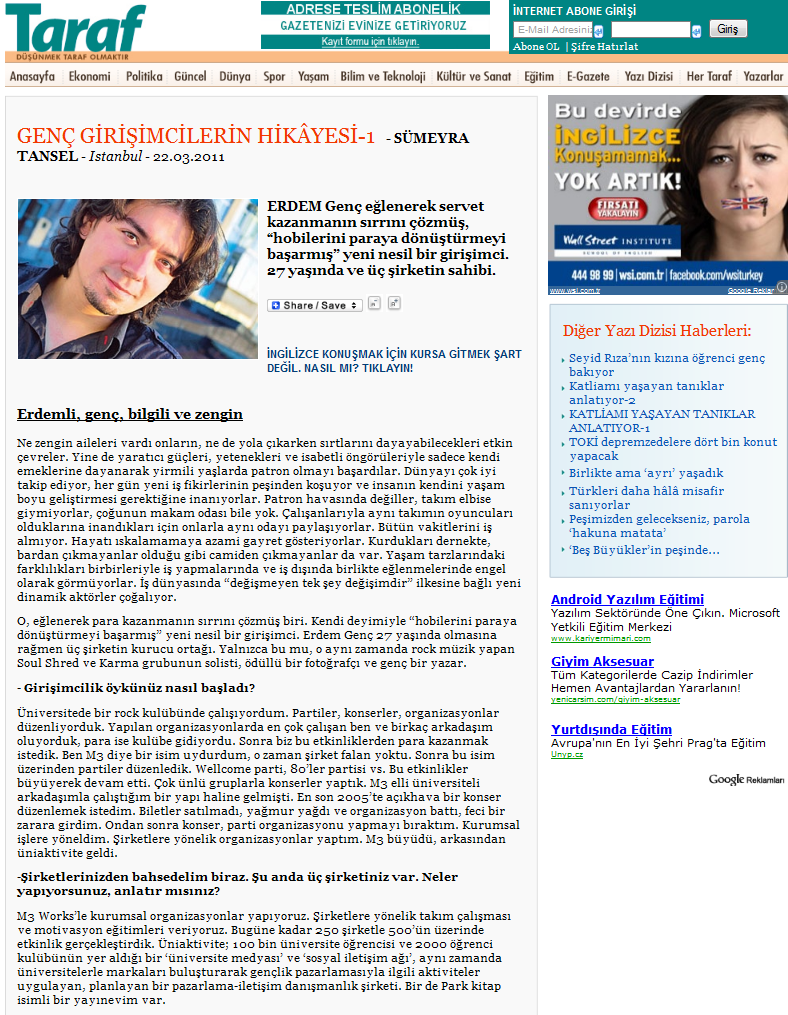
Erdem Genç: Virtuous, Young, Well-Informed and Wealthy
Virtuous, young, well-informed and wealthy
Erdem Genç is a new-generation entrepreneur who has cracked the secret of making a fortune while having fun and has “managed to turn his hobbies into money”. He is 27 years old and the owner of three companies
They had neither wealthy families nor influential circles to lean on when they set out. Even so, with their creative power, their talent and their well-judged foresight, they managed to become bosses in their twenties by relying on nothing but their own efforts. They follow the world very closely, chase new business ideas every day and believe that a person should keep developing themselves throughout life. They don’t put on boss-like airs, they don’t wear suits, and most of them don’t even have an executive office. Because they believe they and their employees are players on the same team, they share the same room with them. Work does not take up all of their time. They make every effort not to let life pass them by. In the association they have founded there are those who are never out of the bar, just as there are those who are never out of the mosque. They do not see the differences in their lifestyles as an obstacle to doing business with one another or to having fun together outside work. In the business world, the new, dynamic players committed to the principle that “the only thing that doesn’t change is change” are growing in number.
He is someone who has cracked the secret of making money while having fun. In his own words, a new-generation entrepreneur who has “managed to turn his hobbies into money”. Although Erdem Genç is only 27, he is the co-founder of three companies. And that is not all: he is also the lead singer of the rock bands SoulShred and Karma, an award-winning photographer and a young author.
– How did your entrepreneurship story begin?
I was working at a rock club at university. We organised parties, concerts and events. At those events it was always me and a few friends who worked the hardest, while the money went to the club. Then we decided we wanted to make money from these events ourselves. I made up the name M3; there was no company or anything back then. After that we organised parties under this name: a Welcome party, an 80s party and so on. These events kept growing. We put on concerts with very famous bands. M3 had become an outfit in which I worked with fifty friends from university. Finally, in 2005, I wanted to stage an open-air concert. The tickets didn’t sell, it rained and the event went under; I made a terrible loss. After that I gave up organising concerts and parties. I turned to corporate work and organised events for companies. M3 grew, and then came Üniaktivite.
– Let’s talk a little about your companies. You currently have three. Could you tell us what you do?
With M3 Works we organise corporate events. We provide teamwork and motivation training for companies. To date we have held more than 500 events with 250 companies. Üniaktivite is a ‘university media outlet’ and ‘social communication network’ that brings together 100,000 university students and 2,000 student clubs; it is also a marketing and communications consultancy that plans and carries out youth-marketing activities by bringing universities and brands together. And I also have a publishing house called Park Kitap.
– How did the idea of setting up a publishing house develop?
Three years ago my first short-story collection, Debut, came out. Although the book was published by a small publishing house on not very favourable terms, my friends and I pursued a serious marketing strategy online, and that enabled the book to reach a considerable readership. We managed to catch the attention of many journalists in the national media, and the book was covered in a good number of newspapers and magazines. Then I realised we could do this job; I loved writing, and I said, why shouldn’t I have a publishing house? I came to an agreement with a friend who knows this business very well and opened Park Kitap. That friend is now at the helm and takes care of everything; I only put up the capital.
– What are you doing at Park Kitap?
Park Kitap is a new venture, a three-month-old publishing house, but we are already in profit. We currently have five books in print, and five more are on the way. Under the Park Kitap umbrella we run writing, poetry and short-story workshops. We are raising our own authors here. Once the students attending the workshops reach a certain level, we publish the stories they write. So far we have three hundred students attending, and when the workshop programme ends we will publish some of the stories these students have written as a book.
– How did you decide to move from engineering into a different field?
The mechanical engineering internships I did while at university steered me in this direction. Throughout the internship, in order to get to work on time I would leave home at six in the morning and, if there was no traffic, get back at half past eight in the evening; I had only a few hours of the day left to myself. I realised that if I did this job I wouldn’t be able to spend the time I wanted with my girlfriend, my family and my hobbies, and I said, ‘I don’t want a life like this.’ Then I decided what I did want and went after it. At the beginning you pay a heavy price. The first two or three years are very hard; you struggle, but once your business takes off everyone is happy. So my advice to everyone is not to be afraid of those early hardships. Many of my friends tried once or twice and gave up when it didn’t work out.
I grew up in my father’s shop
– Has the way you were brought up had an effect on your success today? What kind of childhood did you have?
I was a child with a lot of toys. That is why I love fun things like these, and I still have a lot of toys. The desk in my office is covered with them. My family supported me up to a point and also didn’t; they wavered between the two. My father ran a grocery shop in Harbiye and my mother was a housewife. Being in Harbiye, it was rather different from an ordinary neighbourhood grocer’s. All sorts of characters, from professors to drunks, came in from morning till night. I stood at the till from primary school onwards. That did a great deal to teach me about trade. When I was nine, my father would leave the shop to me and go off. From an early age I tried to work, to talk to everybody and to get to know every kind of person.
– What did you do during your school years?
At primary school I brought out a photocopied environmental magazine with my friends; at middle school I was editor of the school newspaper, called 8-D Postası. In my high-school years a case was brought against me because of Metal Monster, a rock music magazine I published having forgotten to obtain the legal permits. At that time I was writing for the magazines Şebek and Köprüaltı. Later I sorted out the permit and carried on publishing Metal Monster until 2004. I also wrote for DreamDergi until it closed down.
– What do you do outside work?
Actually, my pursuits outside work are just like my work; that is, I take photographs as a hobby and I do it professionally too. For example, together with a London photographer I opened an exhibition at the İstanbul Sanat gallery called ‘The Modern Face of Modern Istanbul’. I have also worked as a fashion photographer and earned money from it. I have won prizes in many major photography competitions. I teach it, too; in other words, my hobby became my job. I also love playing percussion, for instance, and when we go to companies to deliver training I quietly take my place among the colleagues playing percussion, as if I weren’t the boss. I am happy to turn the things I enjoy into money; money didn’t bring happiness, happiness brought money – for me it worked the other way round. But that also comes down to keeping your perceptions open and being able to make the most of it.
A CV full of holes won’t do
– What advice would you give young people?
A career begins at university; unfortunately that’s how it is now. So ‘let me just idle my way through university and have a good time’ – unfortunately you don’t have that luxury. Mind you, I did go out and have a good time, but I was a bit luckier because I did it as work. If you can, do the same; I recommend it. When I wanted to go on holiday to Uludağ, I would organise an Uludağ trip. We would all go together. I would be the only one there not spending any money – in fact, I’d be making money on top. My friends used to say, ‘This guy has worked out the formula for making money while having fun.’ At university you need to gain experience and find out what you can and cannot do in later life. Try it and carry on, or, if it isn’t working, try it and drop it – but you need to determine what kind of path you will walk in the future. At university you have that freedom. Otherwise, later on, as someone who has worked two months in one place and three months in another and left when it didn’t work out, you will have a CV full of holes. When you apply somewhere else with that CV, it will be hard for you to be accepted.
I play and I sing
Born in 1983, from Karabiga, Çanakkale. A graduate in mechanical engineering from Yıldız Teknik Üniversitesi. Co-founder of the companies Üniaktivite, which brings university students and brands together, and M3 Works, which runs motivation workshops for companies. He also owns a publishing house called Park Kitap. He sings in the bands Karma and SoulShred, and has been playing percussion with M3 Ritm Atölyesi since 2006. He has a short-story collection called Debut. Two more books of his are due out soon. He is a columnist for Fortune magazine and the newspaper Alternatif Süreç.